
Virginia DMV Permit Practice Test 9
Test 9 of 10. Pick an answer for each question to see if it is right and why; your score appears at the end. You need 34 correct answers to pass, the same ratio as the real Virginia test.
- Questions40
- Correct to pass34
- Passing score85%
- Minimum age15 years 6 months
-
1. You are about to descend a long steep grade. How should you control your speed?
Show answer
Answer D: Select a lower gear before starting down and use the brakes in firm, brief applications
Engine braking in a lower gear carries most of the load down the grade, while continuous brake pressure overheats the brakes and reduces their effectiveness.
-
2. The road ahead is broken up with potholes and rough patches. What should you do?
Show answer
Answer C: Slow down, since a hole hit at speed can wreck a tire or wheel
A lower speed cuts the impact on tires, wheels and suspension and gives you time to choose a line through the rough surface.
-
3. How do extra passengers affect a driver, especially a new one?
Show answer
Answer A: They increase the chance of distraction and of crashes
Conversation, laughter and horseplay pull a driver's attention away from the road. Crash risk for young drivers rises with each additional passenger.
-
4. At what apparent total property damage threshold must a Virginia law enforcement officer who investigates a crash forward a written report to the DMV?
Show answer
Answer B: 3,000 dollars or more
A Virginia law enforcement officer who investigates a crash resulting in injury, death, or apparent total property damage of 3,000 dollars or more must forward a written report to the DMV within 24 hours of completing the investigation.
-
5. You see smoke coming from under the hood while driving. What should you do?
Show answer
Answer D: Signal, pull well off the road, shut off the engine and move everyone away from the vehicle
Stopping and shutting off the engine cuts the fuel supply to a possible fire, and distance protects you if it spreads. Raising the hood can feed the fire a rush of air.
-
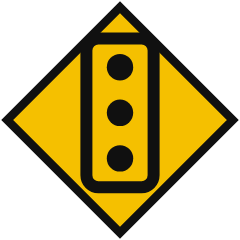
6. Why would this sign be installed on an approach?
Show answer
Answer B: Because the signal cannot be seen from far enough back for a driver to react in time
Advance notice of a signal is used where a crest, a curve, trees or a building keep the signal heads out of view until a driver is already too close to stop comfortably.
-
7. You are backing out of a driveway that crosses a public sidewalk. What should you do?
Show answer
Answer C: Stop before the sidewalk and check both ways
Walkers, runners and riders use the sidewalk at speeds that can bring them into your path in a second, so the stop and the look belong before the sidewalk, not after it.
-
8. How should you handle a prescription or over the counter medicine before driving?
Show answer
Answer D: Read the label and ask a pharmacist or doctor whether it affects driving
Many common medicines, including allergy and cold remedies, cause drowsiness or slowed reactions, and the label or a pharmacist can tell you whether driving is safe.
-
9. A Virginia driver has a prior DUI-related conviction within the last 10 years and now unreasonably refuses a breath or blood test again. How is this second refusal treated?
Show answer
Answer D: As a Class 1 misdemeanor with a three year suspension of driving privileges
A second or subsequent unreasonable refusal within 10 years is a Class 1 misdemeanor in Virginia and carries a three year suspension of driving privileges.
-
10. When should you enter a destination into a navigation device?
Show answer
Answer B: Before you start driving, or after parking in a safe place
Programming a route is a visual, manual and mental task at the same time, so it belongs to the moments before the vehicle moves rather than to any point in traffic.
-
11. Who is legally permitted to operate a low-speed vehicle on a Virginia public highway?
Show answer
Answer C: Only a person who holds a driver's license or a learner's permit
Virginia law limits operation of low-speed vehicles on public highways to persons who hold a driver's license or a learner's permit.
-
12. What is the minimum light transmittance Virginia requires for tinting film applied to the front side windows of a vehicle?
Show answer
Answer C: At least 50 percent
Virginia law prohibits sun-shading or tinting film on front side windows that reduces total light transmittance below 50 percent.
-
13. At a freeway exit, the paved triangle between the ramp and the through lanes is filled with diagonal white lines. What do they mean?
Show answer
Answer A: Stay out of that area, because it is not meant to be driven on
Chevron and diagonal markings fill paved areas that traffic is not intended to use, so drivers should keep out of them.
-
14. You are driving slower than the general flow on a multilane highway. Which lane should you use?
Show answer
Answer D: The right lane, keeping the left lanes free for faster traffic and passing
Slower traffic must keep right so that faster vehicles and overtaking traffic can use the left lanes without weaving between lanes.
-
15. You will leave your vehicle for several hours after dark. Where is the best place to park it?
Show answer
Answer D: In a well-lit spot with people and cameras nearby
Light, passing people and cameras all discourage theft and make your own return to the vehicle safer.
-
16. During what part of the year does Virginia law permit the use of studded tires?
Show answer
Answer C: From October 15 through April 15
Virginia law permits studded tires only from October 15 through April 15 each year.
-
17. You are approaching a sharp curve. When should you reduce your speed?
Show answer
Answer D: Before you enter the curve, so you can accelerate gently through it
Braking hard inside a curve uses up the traction that is already being demanded for cornering, so the slowing must be finished before you enter.
-
18. How often must a registered Virginia vehicle undergo a state safety inspection?
Show answer
Answer D: At least once every 12 months
Virginia requires a registered vehicle to be reinspected at least once every 12 months following its first inspection or purchase.
-
19. What is the correct order of steps as you finish parking an automatic on a grade?
Show answer
Answer C: Turn the wheels, set the parking brake, then select park
Setting the parking brake before shifting into park lets the brake take the load, instead of leaving the whole weight of the car on the parking pawl.
-
20. When a Virginia law enforcement officer measures window tint for compliance, what tolerance is built into the measurement?
Show answer
Answer D: A tolerance of minus seven percentage points
Virginia gives law enforcement officers a tolerance of minus seven percentage points when measuring window tint light transmittance for compliance.
-
21. How does Virginia classify a third DUI conviction that occurs within 10 years of a prior conviction?
Show answer
Answer B: A Class 6 felony, carrying a mandatory minimum fine of 1,000 dollars
Virginia elevates a third DUI conviction within 10 years to a Class 6 felony with a mandatory minimum fine of 1,000 dollars and a mandatory minimum jail term, which grows to six months if all three convictions fall within five years.
-
22. Your exit from a three-lane highway is about a mile ahead on the right, and you are in the left lane. What should you do?
Show answer
Answer B: Start moving right now, one lane at a time
Plan ahead and change lanes one at a time well before the exit, so you never have to cut across several lanes at the gore.
-
23. The hood of your vehicle flies open while you are driving and blocks your view. What should you do?
Show answer
Answer A: Look through the gap beneath the hood or out the side window, slow down and pull off the road
You usually still have a narrow view under the raised hood or through the side window. Use it to steer, slow gradually and get clear of traffic before securing the hood.
-
24. You are following a large truck on a two-lane road and cannot see past it. What should you do before deciding to pass?
Show answer
Answer D: Drop back so that your view of the road ahead opens up
Distance is what buys you a view around a large vehicle, and no decision to pass can be made from a position where you cannot see.
-
25. Do family or household members count toward the passenger limit that applies to a Virginia provisional license holder?
Show answer
Answer B: No, family and household members are exempt from the passenger limit
Virginia's passenger restriction for provisional license holders exempts family and household members, so they do not count against the one-passenger limit.
-
26. Unless a sign posts otherwise, what is the Virginia speed limit on all roads that are not in a school, business or residential area and are not unpaved?
Show answer
Answer C: 55 miles per hour
Virginia sets a default of 55 miles per hour for all other roads when no other speed limit is posted.
-
27. Virginia's ban on wearing earphones in both ears while driving includes an exception for certain noise-cancellation headsets. Who may use this particular exception?
Show answer
Answer B: An operator of a vehicle with a gross vehicle weight rating of 26,000 pounds or more, using a closed-ear, open-back device designed for high-noise environments
Virginia's earphone exceptions include closed-ear, open-back noise-cancellation devices designed for vehicle operators in high-noise environments, but only for vehicles with a gross vehicle weight rating of 26,000 pounds or more.
-
28. Which statement best describes what the basic speed law requires of you?
Show answer
Answer C: That you never drive faster than is reasonable and safe for the conditions
Nearly every state has a basic speed law that makes the conditions the real limit: weather, traffic, light and road surface can all require a speed well below the posted number.
-
29. When must a Virginia driver turn on the vehicle's headlights due to weather, according to state law?
Show answer
Answer B: Whenever windshield wipers are in continuous use because of fog, rain, sleet or snow
Virginia law requires headlights to be turned on whenever windshield wipers are in continuous use as a result of fog, rain, sleet or snow.
-
30. A train has just cleared a crossing that carries two sets of tracks. What should you do?
Show answer
Answer B: Wait and look both ways for a second train
A passing train hides a second train on the other track, so wait until the signals stop and you can see that both tracks are clear.
-
31. You see brake lights several vehicles ahead of you in your lane. What is the best first step?
Show answer
Answer C: Ease off the gas and cover the brake pedal
Reacting to the trouble several vehicles ahead, rather than waiting for the car in front, cuts your reaction time and warns the driver behind you.
-
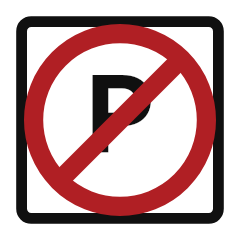
32. A driver leaves the vehicle at the curb where this sign is posted and walks away for two minutes. Is that allowed?
Show answer
Answer B: No, leaving the vehicle unattended there is prohibited whatever the length of the absence
Walking away leaves the vehicle parked, and the prohibition holds regardless of how long the driver is gone or whether the engine is left running.
-
33. You are circulating in a roundabout and a vehicle is waiting to enter ahead of you. What should you do?
Show answer
Answer D: Keep going, because circulating traffic does not stop for entering vehicles
Stopping in the circle to be polite surprises the drivers behind you and defeats the design; entering traffic is the side that waits.
-
34. A tractor-trailer is backing slowly across the roadway to enter a loading dock. What should you do?
Show answer
Answer C: Stop and wait until the truck has finished the maneuver
A backing truck driver has a very limited view and the trailer can swing unexpectedly. Trying to squeeze past in either direction risks being crushed.
-
35. There is a driveway and a side street between you and the corner where you will turn right. When should you signal?
Show answer
Answer C: After passing the openings, so nobody pulls out in front of you
A signal switched on before an opening tells drivers waiting there that you are turning in, and they may pull out into your path.
-
36. A yellow diamond shows a horse with a rider. Besides slowing down, what else should a driver do?
Show answer
Answer C: Avoid using the horn or revving the engine
The equestrian crossing sign warns of horses on or across the road, and a sudden noise can startle an animal into the traffic lane.
-
37. You are driving on an open highway in a strong crosswind. What is the safest adjustment?
Show answer
Answer A: Reduce speed and keep a firm grip, expecting gusts on bridges and beside large vehicles
Gusts hit hardest in open gaps, on bridges and when passing high-sided vehicles, so a lower speed and a firm grip let you correct before you are pushed out of your lane.
-
38. On a long, straight highway you feel your attention fading. What helps you stay alert?
Show answer
Answer A: Keep your eyes moving, scan mirrors and signs, and take regular breaks
Staring at one point brings on highway hypnosis. Active scanning keeps the mind engaged, and a break every couple of hours restores alertness.
-
39. The inside of your windshield keeps fogging up on a cold, damp day. What clears it best?
Show answer
Answer B: The defroster with the air conditioning on, which dries the air
Fog on the inside is moisture from the cabin air. The air conditioner dries that air, and the defroster warms the glass, so together they clear it and keep it clear.
-
40. You are following a tractor-trailer so closely that its rear doors fill your windshield. What is the main problem?
Show answer
Answer D: You cannot see the road ahead and the truck driver cannot see you
A truck has a deep blind spot directly behind it, and tailgating also hides everything in front of the truck from you. Drop back so you can see and be seen.