
Virginia DMV Permit Practice Test 2
Test 2 of 10. Pick an answer for each question to see if it is right and why; your score appears at the end. You need 34 correct answers to pass, the same ratio as the real Virginia test.
- Questions40
- Correct to pass34
- Passing score85%
- Minimum age15 years 6 months
-
1. What right-of-way does a Virginia funeral procession have while traveling under a police or sheriff's escort?
Show answer
Answer B: The procession has the right-of-way on any highway through which it passes
A Virginia funeral procession traveling under police or sheriff escort has the right-of-way on any highway through which it passes, and other vehicles may not join, pass through or interfere with it.
-
2. In a work zone a flagger is directing traffic in a way that conflicts with the posted signs. Whom do you follow?
Show answer
Answer B: The flagger's directions
A flagger controls traffic through a work area that changes from day to day, and those instructions take precedence over the fixed signs and markings in that zone.
-
3. Which of these is a recognized exception to Virginia's midnight to 4 a.m. driving curfew for a provisional license holder?
Show answer
Answer A: Driving to or from an activity supervised by an adult and sponsored by a school, civic, religious or public organization
Virginia's curfew for provisional license holders does not apply while driving to or from an activity that is supervised by an adult and sponsored by a school or by a civic, religious or public organization.
-
4. At which location is this sign normally installed?

Show answer
Answer D: Facing traffic that could turn into a one-way roadway or ramp against the flow
It is posted where a driver could otherwise enter a ramp or a one-way roadway from the wrong end, so it faces exactly the traffic that has to be kept out.
-
5. Why can an oncoming vehicle that looks comfortably far away leave you far less room than you expect?
Show answer
Answer D: You and that vehicle close the gap at the sum of both your speeds
Two vehicles approaching at 55 mph each close the distance between them at about 110 mph, so the gap disappears in half the time you would expect.
-
6. Within how many days of establishing Virginia residency must a new resident title a vehicle with the Virginia DMV?
Show answer
Answer C: 30 days
A new Virginia resident must title a vehicle with the DMV within 30 days of establishing residency, a shorter window than the 60 days allowed to obtain a Virginia driver's license.
-
7. How does marijuana affect a driver?
Show answer
Answer C: It slows reaction time and impairs judgment of time and distance
Marijuana impairs coordination, attention and the ability to judge speed and distance. Driving while impaired by it is illegal everywhere, even where its use is legal.
-
8. Someone has stepped into a marked crosswalk in the middle of a block ahead of you. What should you do?
Show answer
Answer A: Slow down, stop before the markings and let the person cross the street
A marked mid-block crosswalk carries the same duty as one at a corner: give way to the person crossing, stopping if that is what letting them cross safely takes.
-
9. In Virginia, what must a driver do when passing a stationary trash collection vehicle on a highway of fewer than four lanes?
Show answer
Answer A: Slow to 10 miles per hour below the posted limit and pass at least two feet to the left of the vehicle
On a highway of fewer than four lanes, or when a lane change is not possible, Virginia requires slowing to 10 miles per hour below the posted limit and passing at least two feet to the left of the trash collection vehicle.
-
10. Why does a heavier vehicle need more room to stop than a light one from the same speed?
Show answer
Answer B: Because there is more mass in motion for the tires to slow down
More mass means more energy at the same speed, and the brakes and tires need more distance to get rid of it.
-
11. You are stopped in slow traffic and a motorcycle comes up between the lanes. What should you do?
Show answer
Answer D: Hold your position and avoid any sudden lane change
The danger to a rider between lanes comes from a vehicle moving sideways without warning, so staying predictable is what protects them.
-
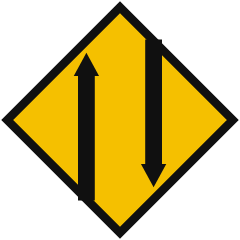
12. What is a driver being warned about here?
Show answer
Answer B: The pavement ahead carries vehicles traveling in the opposite direction
Beyond this point vehicles come the other way on the same pavement, which commonly happens where a one-way section or a separated stretch comes to an end.
-
13. Under Virginia law, a passenger is under 18 but old enough not to need a child restraint device. What must the driver ensure for that passenger?
Show answer
Answer B: The passenger is provided with and properly secured by an appropriate safety belt system
Virginia requires a driver to ensure that any passenger younger than 18 who does not need a child restraint device is provided with and properly secured by an appropriate safety belt system.
-
14. A traffic signal is dark and you reach the intersection at the same moment as a vehicle on your right. Who goes first?
Show answer
Answer A: The vehicle on your right, as at any all-way stop
A dark signal is treated as an all-way stop, and the usual tie-breaker then applies: the vehicle on the right goes first.
-
15. Why is dusk one of the harder times of day to drive?
Show answer
Answer B: The failing light blurs shapes into the background
In fading light there is not enough contrast to pick objects out, yet it is not dark enough for headlights to do the work, so pedestrians and cyclists disappear.
-
16. Your light turns green while a pedestrian who started on the walk signal is still crossing in front of you. What must you do?
Show answer
Answer D: Let them finish crossing the road before you move off on your green light
A pedestrian who entered the crosswalk lawfully keeps the right of way until they reach the other side, whatever the signal now shows.
-
17. Visibility drops suddenly and you decide to leave the highway. What is the safest way to do it?
Show answer
Answer A: Take the next exit or a wide pull off, well clear of the traffic lanes
Get right off the traveled way, and off the shoulder too if you can, because vehicles in poor visibility often drift onto the shoulder.
-
18. Once you are moving, which way of using a navigation device costs you the least attention?
Show answer
Answer B: Listening to the spoken directions
Voice guidance lets you keep your eyes on the road, while anything that needs the screen takes glances that add up over a trip.
-
19. You are behind a snow plow working on a highway. What is the correct way to drive?
Show answer
Answer C: Stay well back and do not try to pass it
A plow throws snow, runs wider than its body and works on the poor surface ahead of it, so the cleared road behind it is the safest place to be.
-
20. A high truck ahead of you hides the traffic signal as you approach the intersection. What should you do?
Show answer
Answer A: Drop back so you can see the signal and the truck's brake lights
Extra following distance restores your view of the signal, so you are reacting to the light yourself rather than copying the truck driver.
-
21. You notice a bulge on the sidewall of one of your tires. What should you do?
Show answer
Answer D: Have the tire replaced before driving far, because it could blow out
A sidewall bulge means the internal cords have broken and only the rubber is holding the air. The tire can fail suddenly at any speed.
-
22. What is the main limit of stability and traction control systems?
Show answer
Answer B: They cannot create grip that the tires and the road do not have
These systems manage the grip that exists. If you enter a curve too fast for the surface, no amount of electronics will hold the vehicle on the road.
-
23. You are backing out of a space in a parking lot. Who has the right of way?
Show answer
Answer D: Traffic already moving in the lane, and pedestrians walking behind you
A driver backing out must yield to vehicles and pedestrians already using the lane, because backing is the movement with the poorest view.
-
24. You are about to pass a long tractor-trailer on a two-lane road. What should you expect?
Show answer
Answer B: You will need more clear road, since the vehicle is much longer
A tractor-trailer can be 70 feet long, so passing it takes more distance and more time than passing a car at the same speed difference.
-
25. Blue pavement markings are used together with white markings at
Show answer
Answer D: parking spaces reserved for people with disabilities
Blue supplements the white markings of accessible parking spaces, which is the only assignment blue has on the pavement.
-
26. How many demerit points does a Virginia conviction for following too closely carry?
Show answer
Answer C: Four points
Virginia assigns four demerit points to a conviction for following too closely, placing it among the relatively serious offenses on the state's point scale.
-
27. A driver is convicted of a second DUI in Virginia within five years of the first conviction. What mandatory minimum confinement applies?
Show answer
Answer A: Twenty days in jail, as part of a term of not less than one month
A second DUI conviction within five years in Virginia carries a jail term of not less than one month, of which twenty days is a mandatory minimum, along with a mandatory minimum fine of 500 dollars.
-
28. What is the usual result of driving well above the flow of traffic on a typical trip?
Show answer
Answer B: Very little time saved, with much greater risk
Signals, traffic and short distances swallow the theoretical gain, while crash risk and crash severity both climb sharply with speed.
-
29. What is the minimum mandatory fine for a first conviction of driving under the influence in Virginia?
Show answer
Answer B: 250 dollars
A first DUI conviction in Virginia is a Class 1 misdemeanor carrying a mandatory minimum fine of 250 dollars.
-
30. You are stopped at an intersection where bushes block your view of cross traffic. What should you do?
Show answer
Answer A: Edge forward slowly until you can see, then proceed when clear
Creeping forward a little at a time lets you gain a view without committing to the crossing. Never enter an intersection you cannot see into.
-
31. You are leaving a private driveway and entering a public street. What are you required to do?
Show answer
Answer B: Stop and yield to traffic on the street and to pedestrians on the sidewalk
A driver entering a roadway from a driveway, alley or private road must stop and yield to traffic on the roadway and to pedestrians on the sidewalk being crossed.
-
32. Under what circumstance can the maximum speed limit on a Virginia interstate highway be set as high as 70 miles per hour?
Show answer
Answer C: Where lawfully placed signs authorize it, following a traffic engineering study of the segment
Virginia law allows a 70 mile per hour maximum on interstate highways, other multilane divided limited access highways and certain HOV lanes, but only where lawfully placed signs authorize it after a traffic engineering study.
-
33. An exit ramp is separated from the highway by a triangle of pavement painted with white stripes. What may you do there?
Show answer
Answer C: Nothing; keep off it and choose either the lane or the ramp
The striped area between a ramp and the through lanes is not for driving, stopping or last-second changes of direction.
-
34. Which of these is announced with the same family of signs as the facility shown here?

Show answer
Answer A: A rest area for travelers
A rest area belongs to the same motorist service series, which points travelers toward facilities such as fuel, food, lodging and medical care.
-
35. You are driving on the through road of a T-intersection and want to turn left into the side road. Oncoming traffic is approaching on the through road. What must you do?
Show answer
Answer C: Yield to the oncoming traffic before you turn
The vehicle waiting in the stem of the T yields to both of you, but you still owe the right of way to oncoming through traffic before turning across it.
-
36. A pedestrian steps off the curb in the middle of a block where there is no crosswalk at all. What is the legal position?
Show answer
Answer A: They must yield to you, but you must still avoid a crash
A pedestrian crossing away from a crosswalk yields to vehicles, yet every driver still has a duty to use care and avoid hitting a person.
-
37. Where among these is parking specifically prohibited?
Show answer
Answer A: On a bridge, in a tunnel or on railroad tracks
Bridges and tunnels have no safe refuge and cannot be widened, and a vehicle left on railroad tracks cannot be avoided by an approaching train.
-
38. How does Virginia's safe driving point credit work to offset demerit points on a driving record?
Show answer
Answer C: One point is credited for each calendar year of safe driving, up to a maximum of five points, applied to offset the earliest eligible conviction
Virginia credits one safe driving point for each calendar year without a conviction, up to a maximum of five points, and applies those points to offset the earliest conviction still carrying demerit points.
-
39. How early may a Virginia driver renew a driver's license before its expiration date?
Show answer
Answer B: Up to one year before expiration
Virginia allows a driver to renew a license online, by mail or in person as early as one year before it expires.
-
40. In Virginia, what type of license carries the curfew and passenger restrictions discussed in the graduated licensing rules?
Show answer
Answer C: A provisional driver's license, which by definition is held by a driver under 18
Virginia's curfew and passenger restrictions attach to the provisional driver's license, the license type issued to a driver who is under 18.