
Virginia DMV Motorcycle Practice Test 19
- Questions25
- Correct to pass20
- Passing score80%
- Minimum age15 years 6 months
-
1. After turning right you see a sign showing that your lane ends a short way ahead. What should you do?
Show answer
Answer B: Signal and merge into the next lane while there is still room
Merge early and smoothly while a gap is still available, rather than running out of pavement or forcing your way in at the last moment.
-
2. Which surfaces usually offer less grip than the pavement around them when wet?
Show answer
Answer B: Painted markings, metal plates and bridge decks
Paint, steel and bridge decks all shed grip when wet or cold, so brake before you reach them rather than on top of them.
-
3. A Virginia driver has a prior DUI-related conviction within the last 10 years and now unreasonably refuses a breath or blood test again. How is this second refusal treated?
Show answer
Answer D: As a Class 1 misdemeanor with a three year suspension of driving privileges
A second or subsequent unreasonable refusal within 10 years is a Class 1 misdemeanor in Virginia and carries a three year suspension of driving privileges.
-
4. You have just been involved in a crash on a city street. Which sequence of first steps is correct?
Show answer
Answer A: Stop where you are, check everyone for injuries, and then make the scene safe
You are required to stop, and the first priority at the scene is people, followed by preventing a second collision.
-
5. At a railroad crossing with no gates and no flashing lights, the crossbuck is normally combined with which sign?
Show answer
Answer C: A yield sign, or a stop sign where an engineering study calls for one
At a passive crossing the crossbuck forms an assembly with a yield sign, or with a stop sign when an engineering study or engineering judgment supports it, so the driver knows who must give way to the train.
-
6. In normal operation, which indication always comes between a green and a red on the same signal face?
Show answer
Answer C: A steady yellow
The yellow change interval must follow every green or green arrow, so a signal can never jump straight from green to red.
-
7. Can a driver be charged with impaired driving after taking a legal over the counter medicine?
Show answer
Answer C: Yes, if the medicine impairs the ability to drive safely
Impaired driving laws cover any substance that affects driving, including cold remedies, allergy pills and sleep aids sold without a prescription.
-
8. How often should a rider change position within the lane?
Show answer
Answer C: As often as the traffic, the road surface and the hazards around you change
Lane position is a tool for keeping space and visibility, and both of those change constantly as traffic and road conditions change.
-
9. A yellow diamond showing a bicycle is posted on a rural road. What should a driver expect?
Show answer
Answer A: Bicyclists crossing or riding along the roadway there
The bicycle warning sign is used where a bikeway crosses the road or where riders are likely to be in the traffic lanes, so drivers should look carefully and pass wide.
-
10. A fire truck with lights and siren has just passed you and is heading down the same road. How closely may you follow it?
Show answer
Answer B: Well back, because following a responding emergency vehicle closely is illegal
Following a responding emergency vehicle closely is prohibited; the exact minimum distance is set by each state, so stay far enough back to keep the scene and other responders clear.
-
11. Your group reaches a work zone where the lane has been narrowed by cones and the surface is uneven. What should the formation do?
Show answer
Answer B: Move to single file and give each rider the whole width of the lane
A narrowed or broken surface leaves no spare room inside the lane, so riders need the full lane width each and must drop into single file.
-
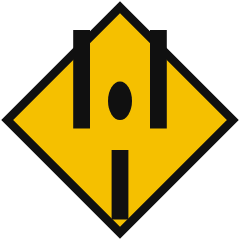
12. What change in the road does this sign announce?
Show answer
Answer B: The two directions of travel are about to be separated, and the driver must keep to the right of the separation
Ahead the roadway splits into separate one-way roadways on either side of a median, so the driver stays to the right of the divider and no longer meets oncoming vehicles.
-
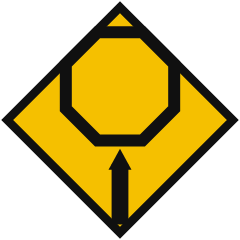
13. On a wet road, how should a driver adjust after passing this sign?
Show answer
Answer B: Start braking earlier, because a slippery surface lengthens the stopping distance
A wet surface lengthens stopping distance, so the extra warning distance should be spent braking gently and early instead of late and hard.
-
14. When should a helmet be replaced?
Show answer
Answer B: After a crash, or if the shell is cracked or the straps are frayed
The energy absorbing liner is designed to crush once, so a helmet that has taken an impact or shows damage no longer offers full protection.
-
15. You are parked legally, but a police officer tells you to move the vehicle. What should you do?
Show answer
Answer B: Move it as directed, because an officer overrides the signs
Directions from a police officer or a firefighter take precedence over signs and markings, whether they are directing traffic or clearing a street.
-
16. Before making a right turn at an intersection, what should you check besides oncoming traffic?
Show answer
Answer B: Your right blind spot and the crosswalk, for cyclists and pedestrians
Right turns often catch a cyclist or a pedestrian coming up on the right, so check the blind spot and the crosswalk before you turn.
-
17. You are passing a line of slow traffic in the lane beside you and you notice a gap in that line ahead. What should you expect?
Show answer
Answer A: A vehicle may pull out of that gap into your lane
A gap in a slow line is an invitation to any driver waiting to turn out of a side street or to change lanes, and they are looking at the gap rather than at you.
-
18. Which common non-prescription medicine is most likely to make a driver drowsy?
Show answer
Answer C: A cold or allergy remedy containing an antihistamine
Antihistamines in cold and allergy remedies are a leading cause of drowsiness behind the wheel, which is why the label carries a warning.
-
19. May you exceed the posted speed limit in order to complete a pass?
Show answer
Answer C: No, the posted limit applies while you are passing too
The limit does not lift for passing; if you cannot complete the pass within it, there is not enough room and you should stay back.
-
20. You have a green light and an ambulance with lights and siren enters the intersection against its red. What should you do?
Show answer
Answer B: Stop and let the ambulance go through
An emergency vehicle answering a call may cross against a red, and every other driver yields to it whatever their own signal shows.
-
21. The rider who was behind you has vanished from your mirrors. What should you do?
Show answer
Answer C: Ease off and pass the word forward so the group can respond
A rider missing from the line may have stopped or had trouble, and the group needs to know at once so it can slow down or pull over safely.
-
22. Another vehicle is passing you on a two-lane road. What should you do with your speed?
Show answer
Answer A: Hold your speed or ease off slightly to shorten the pass
Speeding up strands the passing driver in the oncoming lane, while a steady speed or a slight lift lets the pass finish quickly and safely.
-
23. After restoring privileges following an uninsured vehicle violation in Virginia, for how long must the owner typically file an SR-22 Financial Responsibility Certificate?
Show answer
Answer D: Three years
Virginia requires an owner who restores privileges after an uninsured vehicle violation to file an SR-22 Financial Responsibility Certificate for three years.
-
24. A Virginia driver arrested for DUI unreasonably refuses a breath or blood test for the first time. How is that refusal treated?
Show answer
Answer C: As a civil offense with a one year suspension of driving privileges
A first unreasonable refusal to submit to a breath or blood test in Virginia is a civil offense that carries a one year suspension of driving privileges, separate from any DUI penalty.
-
25. Before the January 1, 2025 increase, what were Virginia's minimum liability insurance limits for a single policy?
Show answer
Answer A: 30,000 dollars per person, 60,000 dollars per crash and 20,000 dollars in property damage
Before the increase that took effect January 1, 2025, Virginia's minimum liability limits were 30,000 dollars per person, 60,000 dollars per crash and 20,000 dollars in property damage.