
Virginia DMV Motorcycle Practice Test 18
- Questions25
- Correct to pass20
- Passing score80%
- Minimum age15 years 6 months
-
1. What is the main reason a rider should keep a generous following distance on a rough, broken road?
Show answer
Answer B: So the rider can see and plan for holes and broken pavement in time to react
The vehicle ahead hides the pavement, so extra space gives you time to spot a hole or a broken edge and to choose a path around it.
-
2. A funeral procession with headlights on is crossing an intersection when your light turns green. What should you do?
Show answer
Answer A: Wait and let the whole procession go through
Most states let a funeral procession stay together once the lead vehicle has lawfully entered an intersection, and in every state you must yield to vehicles already in the intersection, so wait until the line has passed.
-
3. The signal turns green as you approach an intersection. What is the safest practice?
Show answer
Answer B: Look left, then right, then left again, and make sure the intersection is clear before entering
A green light gives permission but does not guarantee the intersection is empty, and a quick scan catches a vehicle running the red or a pedestrian still crossing.
-
4. What should you avoid when a hostile driver pulls alongside you?
Show answer
Answer A: Making eye contact, or answering the gestures in any way at all
Any response, including a look, encourages an aggressive driver, so give none and let the vehicle go.
-
5. Blue pavement markings are used together with white markings at
Show answer
Answer D: parking spaces reserved for people with disabilities
Blue supplements the white markings of accessible parking spaces, which is the only assignment blue has on the pavement.
-
6. You have a green light at a school crossing, but the crossing guard steps out and holds up a stop sign toward you. What must you do?
Show answer
Answer A: Stop, because the crossing guard controls this crossing and outranks the signal
Directions from a crossing guard or a police officer take priority over signals and signs.
-
7. The center line beside your lane is solid yellow while the opposite side has a broken yellow line. What does this mean?
Show answer
Answer D: You may not pass, but traffic in the other direction may
A solid yellow line on your side of the center marks a no-passing zone for your direction only, while the broken line grants the opposing direction a passing zone.
-
8. What should a rider look for in rain gear?
Show answer
Answer A: A riding rain suit that fits close and will not balloon or tear at speed
Rain gear designed for riding stays sealed and stays put in the airstream, while loose garments can flap, tear or interfere with the controls.
-
9. You are approaching a sharp curve. When should you reduce your speed?
Show answer
Answer D: Before you enter the curve, so you can accelerate gently through it
Braking hard inside a curve uses up the traction that is already being demanded for cornering, so the slowing must be finished before you enter.
-
10. A bee gets inside your jacket while you are riding. What is the recommended action?
Show answer
Answer B: Pull off the road and stop before you try to deal with the insect
Being stung hurts, but losing control while swatting hurts much more, so ride to a safe place, stop and then deal with the insect.
-
11. How does alcohol affect a driver's ability to handle several things at once?
Show answer
Answer B: It cuts the ability to divide attention between tasks
Driving means watching the road, the mirrors and the instruments together, and alcohol narrows attention so that one of those tasks is dropped without the driver noticing.
-
12. In most states, how far before a turn must your signal already be on in city traffic?
Show answer
Answer B: At least 100 feet, roughly the length of six or seven cars
Most states require the signal for at least 100 feet before a turn in city driving, which gives drivers behind you time to react before you slow; several require more at higher speeds.
-
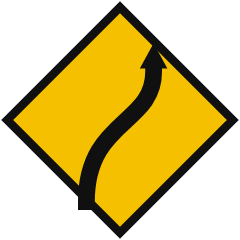
13. A driver holds a steady highway speed into the section this sign warns about. What is the most likely result?
Show answer
Answer B: The vehicle runs wide toward the outside and can cross into another lane or leave the pavement
Holding speed into a change of alignment asks the tires for more side grip than they can supply, so the vehicle runs wide and the driver is left with less room to correct.
-
14. At an intersection the signal flashes red toward you and flashes yellow toward the cross street. Who must yield?
Show answer
Answer D: You must, because the flashing red faces your road
A flashing red means stop and yield like a stop sign, while a flashing yellow lets the other road proceed with caution.
-
15. A truck ahead of you is spreading salt or grit on the road. What should you do?
Show answer
Answer B: Drop back so the material does not reach your car
Spreaders throw material backward and sideways, and following close means stone chips and a screen full of spray, so leave extra distance.
-
16. A lane control sign over one lane shows both a straight arrow and a left arrow. What does it tell drivers in that lane?
Show answer
Answer A: Either movement may be made from that lane
An optional movement lane control sign lists every movement permitted from the lane, so a driver may choose any arrow shown.
-
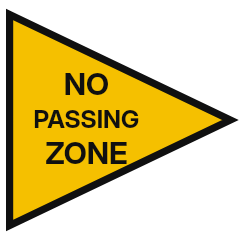
17. A driver is thinking about overtaking a slower vehicle and sees this sign a short distance ahead. What does it mean for that pass?
Show answer
Answer B: The pass must be finished before the restricted section begins
The sign marks the start of a section where passing is prohibited, so a driver may not be on the left side of the road beyond it; any pass has to be completed before that point or not started at all.
-
18. A high truck ahead of you hides the traffic signal as you approach the intersection. What should you do?
Show answer
Answer A: Drop back so you can see the signal and the truck's brake lights
Extra following distance restores your view of the signal, so you are reacting to the light yourself rather than copying the truck driver.
-
19. A police officer in the intersection raises a hand toward you although your signal is green. What should you do?
Show answer
Answer B: Stop and wait for the officer to wave you on
An officer directing traffic overrides signals and signs, and drivers must follow the officer even when the light says otherwise.
-
20. You want to turn left across the oncoming lane into a shopping center driveway. Who must you yield to?
Show answer
Answer B: Oncoming traffic and anyone using the sidewalk
A left turn into a driveway crosses both the oncoming lane and the sidewalk, so you give way to traffic and to pedestrians before completing it.
-
21. Your motorcycle has a grab rail behind the passenger seat. What should the passenger know about using it?
Show answer
Answer C: It is fine to hold, but they must still brace against acceleration
A rail behind the passenger gives a secure grip but does nothing to stop them sliding backward, so they still need to expect the machine to pull away.
-
22. After a Virginia vehicle fails its safety inspection, how much time does the owner have to correct the defects and get the vehicle reinspected?
Show answer
Answer A: 15 days
Virginia requires all defects found during a failed safety inspection to be corrected and the vehicle reinspected within 15 days.
-
23. How long should a glance at a mirror or an instrument take?
Show answer
Answer A: A brief glance of about a second, returning your eyes to the road at once
Checks should be quick flicks of the eyes. At highway speed, a few seconds with your eyes off the road covers a distance long enough for a hazard to appear.
-
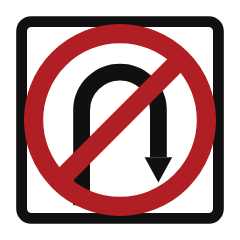
24. Why is this restriction used so often on a divided road just before a crest or a bend?
Show answer
Answer A: Because a vehicle turning across the median there stays hidden from approaching drivers until it is too late
The maneuver needs a long gap and good visibility, and where sight distance is short an approaching driver has no time to react to a vehicle turning across the road.
-
25. How does the distance needed to stop change when a rider doubles speed?
Show answer
Answer D: It grows to roughly four times the original distance
Braking distance rises with the square of speed, so twice the speed needs roughly four times the distance in which to stop.