
Virginia DMV Motorcycle Practice Test 49
- Questions25
- Correct to pass20
- Passing score80%
- Minimum age15 years 6 months
-
1. On a long drive you notice repeated yawning, missed exits and drifting toward the lane line. What should you do?
Show answer
Answer C: Pull off at a safe place and sleep, or change drivers
Those are warning signs that sleepiness is already interfering with driving, and only rest restores alertness. Fresh air, music and caffeine do not reverse it.
-
2. A delivery truck is parked in your lane and you must use the oncoming lane to get around it. Who has the right of way?
Show answer
Answer D: The oncoming traffic, because their lane is clear
The driver whose own lane is obstructed waits, because using the other lane is a favor from oncoming traffic, not a right.
-
3. A rider chooses an open face helmet. What does that choice make necessary?
Show answer
Answer A: Separate goggles or a face shield, because the face is uncovered
An open face helmet gives no eye or face protection, so the rider must add goggles or a face shield that will not shatter and that seals against the wind.
-
4. You have turned onto a ramp at night and your headlights pick out large white arrows painted on the pavement pointing straight back at you. What do they mean?
Show answer
Answer C: You are traveling against the flow and must turn back
Wrong-way arrows are laid so that a driver going the correct way never sees them head on, so an arrow pointing at you means you are on the ramp backwards.
-
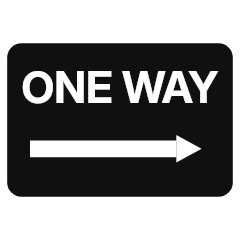
5. Where are signs of this kind placed at an intersection?
Show answer
Answer C: At the near right and far left corners, facing drivers on the intersecting street
They are installed at the corners of the intersecting street so that a driver about to turn in sees the restriction before committing to the turn.
-
6. Why does full riding gear matter on a short trip around the neighborhood?
Show answer
Answer D: Pavement takes skin off at 25 miles an hour just as it does at 55
Serious injuries happen at ordinary street speeds and close to home, so gear that is worth wearing on a long trip is worth wearing on a short one.
-
7. You are turning right from a one-way street onto a two-way street. Where should the turn end?
Show answer
Answer A: In the lane nearest the right curb of the street you are entering
A right turn starts and finishes as close to the right as practical, so you leave the one-way street from the right lane and arrive in the lane nearest the right curb.
-
8. At night you are waiting to turn left and can see only the headlights of an approaching vehicle. Why should you allow a bigger margin?
Show answer
Answer D: Because lights alone make speed and distance hard to judge
With no other visual cues, two points of light give you very little information about how fast the vehicle is closing, so leave extra margin.
-
9. It is dusk and a jogger in dark clothing is running along the edge of the road. What should you do?
Show answer
Answer D: Slow down and scan the edges of the road
Dusk is the hardest light for spotting people, and dark clothing removes most of your warning, so lower speed and a careful scan of the roadsides are the answer.
-
10. While you wait for the ambulance at a crash, what is the most useful help you can give?
Show answer
Answer C: Keep the person still and warm, and press down firmly on any heavy bleeding
Keeping an injured person still and warm and controlling bleeding are among the few things a bystander can safely do.
-
11. Two lanes at the corner are marked for right turns. What does that require of you?
Show answer
Answer A: Keep your own lane through the turn and into the matching new lane
Dual turn lanes work only if each vehicle stays in its own lane all the way round and finishes in the corresponding lane of the new street.
-
12. Which rain suit is the better choice for a rider?
Show answer
Answer A: A bright one with reflective panels, since rain cuts visibility
Drivers see less in the rain, so rain gear is exactly where bright color and reflective material pay off most.
-
13. A flagger turns the paddle to the orange face reading SLOW. What does that tell approaching drivers?
Show answer
Answer D: Reduce speed and continue through the work area with care
The SLOW face keeps traffic moving at a reduced speed while workers or equipment are close to the travel lanes.
-
14. Why is it risky to brake hard and steer sharply at the same moment?
Show answer
Answer C: The tires have a limited amount of grip that braking and turning must share
Each tire can deliver only so much grip, and asking it to slow the vehicle and change direction at once can exceed that limit and start a skid.
-
15. A reduced speed limit posted with this sign and a plaque giving hours is in force

Show answer
Answer C: during the hours shown on the plaque, or while the beacon is flashing
A school speed limit applies during the periods stated on the plaque or while the attached beacon flashes, and the regular limit governs outside those periods.
-
16. You are about to pull out of a driveway when someone on the sidewalk is walking toward it. What should you do?
Show answer
Answer D: Wait, because traffic on the sidewalk has the right-of-way
A vehicle entering the roadway from a driveway yields to people on the sidewalk as well as to traffic on the street.
-
17. You and an oncoming driver are both turning left at the same intersection. What is the usual rule?
Show answer
Answer D: Both turn in front of each other unless markings show otherwise
The normal practice is to pass driver side to driver side, turning in front of one another, unless pavement markings or signs direct a different path.
-
18. You signaled a lane change and the signal did not switch itself off afterwards. Why does that matter?
Show answer
Answer B: Other drivers may act on a turn you do not intend to make
A signal left on tells other drivers you are about to turn, and someone may pull out in front of you. Cancel it as soon as the maneuver is finished.
-
19. Where is a U-turn most clearly unsafe and generally prohibited?
Show answer
Answer D: On a curve or near a hill crest, where other drivers cannot see you
U-turns are barred where approaching drivers cannot see you in time, such as on a curve or near the top of a hill.
-
20. You want to pass on a two-lane road where several people are walking on the narrow shoulder ahead. What should you consider?
Show answer
Answer D: There is no escape room if the pass goes wrong, so wait for a better place
A pass depends on having somewhere to go if it goes wrong, and a shoulder occupied by pedestrians removes that option for both vehicles.
-
21. Oil is visible running down the front fork tubes. What does that mean?
Show answer
Answer C: A fork seal has failed and the suspension needs repair
Fork oil escaping past a seal means the front suspension is losing its damping, and the oil can also reach the front brake and ruin its grip.
-
22. Why should two riders never travel side by side in the same lane?
Show answer
Answer B: Because neither rider has room to swerve if a hazard appears
Riding directly alongside another motorcycle removes the escape path each rider needs to avoid a hazard, a pothole or another vehicle.
-
23. What does Virginia law say about holding a cell phone while driving?
Show answer
Answer A: It is prohibited except in a driver emergency or when the vehicle is lawfully parked or stopped
Virginia prohibits drivers from holding a cell phone or other wireless communication device while driving except in a driver emergency or when the vehicle is lawfully parked or stopped.
-
24. Why are sign shapes and colors standardized across the whole country?
Show answer
Answer D: So a driver knows the kind of message before reading it
Uniform shapes and colors let a driver classify a sign as regulatory, warning or guide from a distance, before the legend can be read.
-
25. As a general rule, how far should you travel along a center two-way left-turn lane before you turn?
Show answer
Answer C: Only a short distance, just enough to slow down and wait for a gap
The center lane is for making or preparing a left turn, so you enter it only shortly before the turn and never travel along it as a through lane; several states set a specific limit such as 200 or 300 feet.