
Virginia DMV Motorcycle Practice Test 44
- Questions25
- Correct to pass20
- Passing score80%
- Minimum age15 years 6 months
-
1. You find that the road surface has turned to sheet ice. What speed is appropriate?
Show answer
Answer A: A crawl, slow enough that you could stop without braking hard
Ice can cut grip to a fraction of normal, so stopping takes many times the usual distance and only a crawl leaves any margin.
-
2. How should a passenger behave through a turn?
Show answer
Answer B: Look over the operator's shoulder in the direction of the turn and avoid sudden movement
Looking over the operator's shoulder into the turn keeps the passenger aligned with the motorcycle, and avoiding sudden movement prevents unexpected changes in balance.
-
3. What kind of gloves are recommended for riding?
Show answer
Answer A: Full fingered gloves of leather or similar durable material
Full fingered leather or equivalent gloves improve grip on the controls and protect the hands, which riders instinctively put out in a fall.
-
4. Why should you avoid parking over tall dry grass or a pile of dead leaves?
Show answer
Answer B: Because the hot exhaust can set the dry material on fire
The exhaust system stays hot for a long time after a drive and can ignite dry vegetation underneath the vehicle.
-
5. A yellow diamond showing the silhouette of a deer warns that
Show answer
Answer D: large animals may cross the road in that area
The sign marks a stretch where animals are known to cross, so drivers should reduce speed and scan both roadsides, especially around dawn and dusk.
-
6. You are waiting to enter a two-lane roundabout and traffic is circulating in both lanes. What must you do?
Show answer
Answer A: Yield to traffic in both circulating lanes before you enter
Every entry to a roundabout is a yield point, and at a two-lane roundabout that means giving way to vehicles in either circulating lane.
-
7. You have stopped on an uphill grade close behind a large truck at a traffic signal. What is the risk?
Show answer
Answer B: The truck may roll back into you when it starts to move
Heavy vehicles can roll backward a short distance when the driver moves from the brake to the accelerator on a hill. Leave extra room when stopped behind a truck on a grade.
-
8. A steady red arrow is displayed for your left-turn lane at a two-way intersection. What must you do?
Show answer
Answer C: Stop and remain stopped until an indication permits the turn
A steady red arrow prohibits the movement it points to, so the driver stops and waits for a green arrow, a flashing yellow arrow or another indication that permits the turn.
-
9. How does Virginia classify the offense of failing to stop for a school bus that is loading or unloading with red lights flashing, when a stop is legally required?
Show answer
Answer A: It is classified as reckless driving
Virginia law provides that a driver who fails to stop for a school bus as required is guilty of reckless driving.
-
10. The traffic signal is green, but the crossing lights on the tracks inside the intersection begin to flash. What must you do?
Show answer
Answer C: Stop clear of the tracks and wait, even though the signal is green
Active crossing warning devices outrank the green indication, so you stop short of the rails and wait until the warning stops.
-
11. On a multi-lane street, a yield line is painted well back from an unsignalized crosswalk rather than right at it. Why?
Show answer
Answer D: So drivers in the other lanes can see the pedestrian
Setting the yield line back keeps a stopped vehicle from hiding a crossing pedestrian from drivers in the next lane, which is a common cause of these crashes.
-
12. Why is dusk one of the harder times of day to drive?
Show answer
Answer B: The failing light blurs shapes into the background
In fading light there is not enough contrast to pick objects out, yet it is not dark enough for headlights to do the work, so pedestrians and cyclists disappear.
-
13. A Virginia resident is 19, already holds a valid Virginia driver's license, and just completed a Virginia Rider Training Program course. What does this allow?
Show answer
Answer A: The person may operate a motorcycle for 30 days from course completion without first obtaining a motorcycle learner's permit
Virginia allows a licensed driver age 19 or older who completes a Virginia Rider Training Program to operate a motorcycle for 30 days after the course without first getting a learner's permit.
-
14. Who must wear a protective helmet on a motorcycle in Virginia?
Show answer
Answer C: Both the operator and any passenger
Virginia requires the motorcycle operator to wear a protective helmet, and passengers are also required to wear an approved helmet.
-
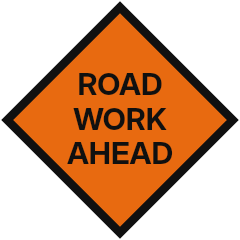
15. How should speed and following distance be adjusted beyond this sign?
Show answer
Answer D: Cut speed and leave a longer gap, because traffic can stop without warning
Traffic in these areas stops and starts unexpectedly and there is little room to steer around a problem, so extra space is what prevents a rear-end collision.
-
16. What is the best path through a curve where you can see all the way to the exit?
Show answer
Answer A: Start toward the outside, move toward the inside, then drift back out
Entering wide, cutting toward the inside and running back out straightens the path, which means less lean angle for the same speed and a better view.
-
17. A sign reads MINIMUM SPEED 40. What does it require of a driver?
Show answer
Answer C: Not to drive below that speed when conditions allow
A minimum speed limit keeps unnecessarily slow vehicles from obstructing traffic, but it never overrides the duty to slow down for weather or congestion.
-
18. Once a Virginia driver's license carries an organ donor notation, how long does that notation remain on the license?
Show answer
Answer A: It remains until the person revokes consent by requesting its removal
Virginia keeps a donor notation on a license or ID card until the individual revokes consent, such as by requesting the notation be removed.
-
19. At roughly what speed can hydroplaning begin when a lot of water is lying on the road?
Show answer
Answer C: At speeds as low as about 35 mph
With enough water and less than perfect tread, a tire can start to ride on the water at around 35 mph, well below normal highway speeds.
-
20. A pedestrian using a white cane or walking with a guide dog starts to cross the street ahead of you. What must you do?
Show answer
Answer A: Yield and stay stopped until the person has finished crossing
A white cane or guide dog identifies a pedestrian who may not be able to see your vehicle, so you must yield and wait rather than maneuver around the person. The horn can confuse the pedestrian or the dog.
-
21. A driver is following you far too closely. What is the best response?
Show answer
Answer D: Increase your own following distance and let the driver pass when it is safe
More room ahead of you means you can slow gradually instead of braking hard, which reduces the chance of being struck from behind, and letting the driver by removes the problem entirely.
-
22. What safety gear does Virginia require of a moped driver and passenger?
Show answer
Answer A: Both must wear a Virginia State Police approved helmet, and the driver must also wear a face shield, safety glasses or goggles unless the moped has a windshield
Virginia requires both the driver and passenger of a moped to wear a Virginia State Police approved helmet, and requires the driver to also wear a face shield, safety glasses or goggles unless the moped is equipped with a windshield.
-
23. The vehicle in front of you has stopped and is waiting to turn left, and there is a paved shoulder to the right. May you use it to get by?
Show answer
Answer D: No, in most states a pass may not be made by leaving the paved travel lanes
Passing on the right is normally lawful only inside the marked travel lanes, and most states prohibit driving onto the shoulder to get around a turning vehicle; the few states that allow it attach strict conditions.
-
24. You are clear of the tracks after your vehicle stalled on a crossing. Whom should you contact?
Show answer
Answer C: The emergency number posted on the blue sign at the crossing, or 911
Grade crossings carry an emergency notification sign with a railroad phone number and a crossing identification number so that approaching trains can be stopped, and 911 works if that sign is not visible.
-
25. A helmet falls from the seat onto a hard floor but shows no cracks. What should the owner do?
Show answer
Answer C: Replace it or have it checked, because the liner can be crushed inside
The foam liner can be compressed with no outside sign, and crushed foam will not absorb a second impact, so a helmet that has taken a hard knock should be replaced.