
Virginia DMV Motorcycle Practice Test 36
- Questions25
- Correct to pass20
- Passing score80%
- Minimum age15 years 6 months
-
1. Two drivers each have three drinks, one over three hours and one in half an hour. What is the difference?
Show answer
Answer C: The fast drinker reaches a higher peak level
The liver removes alcohol at a steady rate, so drinking faster than the body can clear it pushes the blood alcohol level much higher.
-
2. Two vehicles meet on a steep, narrow mountain road with no room to pass. Which driver should back up?
Show answer
Answer C: The driver heading downhill, who has more control while reversing
On a narrow mountain road the vehicle facing downhill yields, because backing uphill gives better control than reversing down a grade.
-
3. A traffic light ahead of the group turns yellow as the leader approaches it. What should the leader do?
Show answer
Answer C: Stop normally and let the group be split by the signal
Keeping the group together never outranks obeying the signal, and the riders left behind simply catch up at the next stop.
-
4. What court penalty does Virginia impose on a driver under 21 convicted of driving after illegally consuming alcohol with a BAC of at least .02 and less than .08?
Show answer
Answer D: A one year suspension plus a minimum mandatory 500 dollar fine or at least 50 hours of community service
Virginia suspends the driving privilege for one year from the date of conviction and imposes either a minimum mandatory fine of 500 dollars or at least 50 hours of community service.
-
5. You have tied a load down with cords that are longer than you need. What should you do with the loose ends?
Show answer
Answer D: Secure the loose ends so nothing can reach the chain, the wheel or the road
A dangling cord can be caught by the rear wheel or the chain and jam it, which can lock the wheel without any warning to the rider.
-
6. Under Virginia law, can an applicant who is younger than 18 designate consent to be an organ donor on a driver's license application without a parent or guardian's approval?
Show answer
Answer D: Yes, a minor may make the donor designation without a parent or legal guardian's consent
Virginia law allows a minor to make an anatomical gift donor designation without the consent of a parent or legal guardian, under the Revised Uniform Anatomical Gift Act.
-
7. Enhanced reference location markers differ from ordinary mileposts in that they
Show answer
Answer B: carry the route number and a mileage figure to the tenth of a mile
An enhanced reference location marker adds the route designation and carries the mileage to a tenth, so the point named is far more precise than a plain milepost.
-
8. How much following distance should you keep behind a motorcycle?
Show answer
Answer C: At least three to four seconds
A motorcycle can slow or stop very quickly and is easily upset by a surprise, so allow three to four seconds instead of the usual car gap.
-
9. You are calling 911 to report a crash. Which information matters most?
Show answer
Answer C: The exact location, how many people are hurt and any hazard such as fire
Dispatchers need to know where to send help, how much help to send, and what dangers the crews will meet on arrival.
-
10. In Virginia, a driver under 21 can be convicted of illegal consumption of alcohol at what blood alcohol content?
Show answer
Answer B: At least .02 but less than .08
Virginia convicts a driver under 21 of illegal consumption when the blood alcohol content is at least .02 but less than .08, while .08 or higher can bring the same penalties as an adult.
-
11. Under what circumstance can the maximum speed limit on a Virginia interstate highway be set as high as 70 miles per hour?
Show answer
Answer C: Where lawfully placed signs authorize it, following a traffic engineering study of the segment
Virginia law allows a 70 mile per hour maximum on interstate highways, other multilane divided limited access highways and certain HOV lanes, but only where lawfully placed signs authorize it after a traffic engineering study.
-
12. How is the rear brake applied on a standard motorcycle?
Show answer
Answer D: By pressing down a pedal with the right foot
The rear brake pedal is in front of the right footrest and should be pressed down smoothly rather than stamped on.
-
13. Which federal standard must a motorcycle helmet meet to be sold for on-road use in the United States?
Show answer
Answer B: FMVSS No. 218
Federal Motor Vehicle Safety Standard No. 218 sets the impact, penetration and retention requirements for motorcycle helmets sold in the United States.
-
14. A rectangular marker with alternating black and retroreflective yellow stripes set at a slant is used to
Show answer
Answer C: mark an obstruction, with the stripes sloping down toward the side on which traffic should pass
This striped panel is an object marker, and the direction in which the stripes slope shows the driver which side of the obstruction to pass on.
-
15. Why is a U-turn on a one-way street a problem?
Show answer
Answer A: You would end up facing the wrong way against all the traffic
Every lane of a one-way street runs the same way, so turning around leaves you driving head-on against all of the traffic.
-
16. Besides drivers of motor vehicles, who else does Virginia's both-ears earphone ban apply to on the highway?
Show answer
Answer C: Riders of bicycles, mopeds and electric power-assisted bicycles
Virginia's earphone restriction is not limited to motor vehicle drivers; it also applies to a person operating a bicycle, an electric personal assistive mobility device, an electric power-assisted bicycle or a moped on the highway.
-
17. The engine begins to lose power, makes a loud noise and starts to seize. What should the rider do?
Show answer
Answer C: Pull in the clutch at once and coast off the road to a safe place
A seizing engine can lock the rear wheel, and pulling in the clutch separates it from the wheel so the motorcycle keeps rolling under control.
-
18. The curb ahead is signed as a bus stop. May you wait there with your vehicle?
Show answer
Answer C: No, the space must stay clear for buses
A bus stop must stay open so that a bus can reach the curb and let passengers on and off safely, so no other vehicle may occupy it.
-
19. How should a group decide how often to stop for fuel?
Show answer
Answer A: By the range of the machine with the smallest fuel tank
Planning around the smallest tank keeps the group from splitting up when one rider has to leave the route to look for fuel.
-
20. How should a rider react to a deer or another large animal in the road?
Show answer
Answer B: Brake and prepare to stop, because large animals move unpredictably
A large animal can bolt in any direction at any moment, so the only reliable response is to slow down and be ready to stop.
-
21. What is a driver being warned about here?
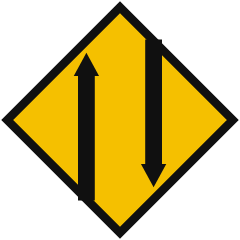
Show answer
Answer B: The pavement ahead carries vehicles traveling in the opposite direction
Beyond this point vehicles come the other way on the same pavement, which commonly happens where a one-way section or a separated stretch comes to an end.
-
22. After a Virginia driver's license holder moves to a new address, how much time does the law give to notify the DMV of the change?
Show answer
Answer B: 30 days
Virginia law requires a license or special identification card holder who moves to notify the DMV of the change of address within 30 days.
-
23. The only person offering you a ride home has been drinking. What should you do?
Show answer
Answer B: Do not get in; find another way home
A passenger in an impaired driver's vehicle shares all of the risk and can do nothing about it from the seat, so the only safe answer is another ride.
-
24. What is the friction zone of the clutch?
Show answer
Answer A: The range of lever travel where power starts to reach the rear wheel
Easing the clutch lever into the friction zone lets the engine drive the rear wheel gradually, which is what makes a smooth start from a stop possible.
-
25. How should a rider use the head and eyes in a turn?
Show answer
Answer A: Turn only the head to look through the turn, keeping the eyes level with the horizon
Turning just the head keeps the upper body from upsetting the motorcycle, and level eyes help the rider judge lean angle and direction.