
Virginia DMV Motorcycle Practice Test 24
- Questions25
- Correct to pass20
- Passing score80%
- Minimum age15 years 6 months
-
1. How should a rider adjust speed on an unlit road at night?
Show answer
Answer C: Slow enough to stop within the distance the headlight actually lights up
A rider can only react to what is visible, so night speed has to fit the distance the headlight reaches rather than the posted limit.
-
2. Why do drivers so often misjudge how fast an approaching motorcycle is traveling?
Show answer
Answer C: A narrow vehicle seems to grow slowly, so it appears further away
A small frontal area changes size slowly as it approaches, so drivers read a motorcycle as further away and slower than it really is. Never assume a waiting driver has judged your speed correctly.
-
3. A car is coming straight at you in your lane and there is no time for it to move back. What should you do?
Show answer
Answer A: Brake, sound the horn and steer to the right, toward the shoulder or ditch
Steering right takes you away from the other vehicle even if its driver corrects course, and the shoulder or ditch is survivable.
-
4. What does a sign reading Slower Traffic Keep Right require?
Show answer
Answer C: Traffic moving slower than the general flow must use the right-hand lane
The sign applies to any vehicle traveling below the speed of the traffic around it, which must keep right so faster vehicles can use the lanes to the left.
-
5. When are the hazard warning lights properly used?
Show answer
Answer A: When your vehicle is stopped or barely moving and is a hazard
Hazard lights warn that your vehicle is an obstruction; they do not authorize illegal parking and they hide your turn signals while driving.
-
6. Some drivers believe they can multitask while driving. What does research show?
Show answer
Answer C: The brain switches rapidly between tasks and driving performance suffers
The brain does not truly do two attention-demanding tasks at once; it alternates between them, and the driving task gets less attention each time.
-
7. A regulatory message is normally carried on a sign whose shape is
Show answer
Answer A: a rectangle standing taller than it is wide
Regulatory signs that state a law, such as speed limits and turn restrictions, use a vertical rectangle with a black legend on a white background.
-
8. How should following distance change when you ride at night?
Show answer
Answer D: Open it up to three seconds or more
Less light means hazards appear later, so a rider should slow down and stretch the following distance to three seconds or more.
-
9. Well before an intersection, an overhead sign shows a diagram of the lanes with an arrow above each one. What is its purpose?
Show answer
Answer C: To let drivers pick the correct lane in good time
Advance intersection lane control signs display the lane assignment far enough back that drivers can move over calmly instead of at the last moment.
-
10. How does going a long time without sleep compare with drinking?
Show answer
Answer A: It can impair a driver in much the same way
Long periods awake produce slow reactions, poor judgment and lapses of attention that resemble the effects of alcohol, which is why fatigue counts as impairment.
-
11. A downpour has just started on a street with a visible dark strip down the middle of the lane. Where should you ride?
Show answer
Answer A: In the left or right portion of the lane, away from the greasy center strip
Dripped oil and grease build up in the center of the lane, and water floats that film to the top, so the tire tracks on either side offer better grip.
-
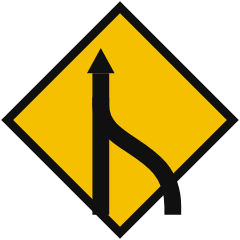
12. Why does the situation ahead of this sign deserve extra care from a motorcyclist?
Show answer
Answer C: Because a narrow machine is easy to overlook in a mirror or a blind spot
A motorcycle fills very little of a mirror and disappears easily into a blind spot, so the rider should adjust speed and lane position to stay visible where the streams come together.
-
13. What color scheme does a standard stop sign use?
Show answer
Answer B: White legend and border on a red background
The stop sign carries a white legend and border on a red background, the color set aside for stop, yield and prohibition messages.
-
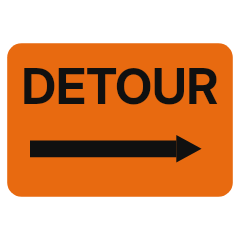
14. Which of these is true of the roadway a driver is being sent onto here?
Show answer
Answer D: Its own signs, signals and speed limits govern for the whole way around
The alternate route is an ordinary public road, so every control posted on it governs as usual; being sent that way grants no extra priority and no relief from the limits in force there.
-
15. You have just had bad news and you feel very upset. What should you do?
Show answer
Answer B: Wait until you have calmed down, or else let somebody else drive
Strong emotion takes attention away from the road as surely as alcohol or fatigue, so it is a reason not to drive yet.
-
16. You are stopped at a stop sign where your road ends at a two-way through street and you plan to turn left. What must you yield to?
Show answer
Answer B: Traffic from both directions and any pedestrians crossing
A left turn from the stem of a T crosses the near lane and joins the far one, so you give way to traffic in both directions and to pedestrians.
-
17. You are fitting a tank bag to your motorcycle. What must you check?
Show answer
Answer B: That it does not foul the handlebars or block your view of the instruments
A bag that catches the bars at full lock or hides the instruments interferes with control of the motorcycle exactly where the rider needs it most.
-
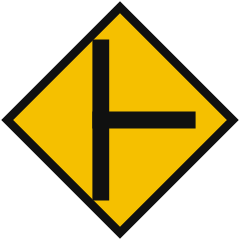
18. What condition does this sign warn a driver about?
Show answer
Answer B: Another road joins the road being traveled, from one side
It announces a side road entering the main roadway, so the driver should expect vehicles waiting to pull out and other vehicles slowing to turn in.
-
19. Your light turns green while a pedestrian who started on the walk signal is still crossing in front of you. What must you do?
Show answer
Answer D: Let them finish crossing the road before you move off on your green light
A pedestrian who entered the crosswalk lawfully keeps the right of way until they reach the other side, whatever the signal now shows.
-
20. You are approaching a multilane roundabout. When should you choose your lane?
Show answer
Answer C: Before you enter, using the lane-choice sign on the approach
You select your lane on the approach the way you would at any multilane intersection, then stay in that lane all the way around, because changing lanes inside a roundabout creates side-impact conflicts.
-
21. A sign with a black legend on a fluorescent pink background is used for
Show answer
Answer A: traffic incident management
Fluorescent pink is set aside for signing that manages traffic around a crash, a spill or another unplanned incident, so it stands apart from routine work zone orange.
-
22. What is the best way to keep your phone from distracting you on a trip?
Show answer
Answer D: Silence it and stow it before you start
A phone you cannot hear and cannot reach cannot tempt you, which is far more reliable than deciding case by case while you drive.
-
23. Once a driver has joined the route this sign begins, how is the rest of the way marked?
Show answer
Answer B: By further markers of the same kind at each turn, until the original road is rejoined
The alternate route is signed continuously, with a marker at every turn, so a driver with no local knowledge can follow it back to the original road.
-
24. How may a two-way left-turn lane never be used?
Show answer
Answer B: As a through travel lane or a passing lane
The lane exists only for turning movements, so traveling or passing along it puts you head-on with vehicles turning from the opposite direction.
-
25. How should your following distance change in heavy rain?
Show answer
Answer D: It should be increased well beyond what you use on dry pavement
Wet pavement lengthens stopping distance and rain cuts visibility at the same time, so a larger gap gives you the extra seconds needed to see a problem and stop for it.